Tree pruning Rome GA: crown reduction vs topping explained
⏱️ 7 min read · Last updated: 2026
Need tree pruning in Rome GA? The safe answer is simple: choose deadwood removal for routine maintenance, and choose crown reduction only when a tree has outgrown its space. This guide explains how to tell the difference between proper pruning and damaging topping, what standards to expect from a qualified arborist, and how to protect the long-term health of your trees in Floyd County’s humid climate.
- Safe pruning limit: Remove no more than 25% of a tree’s live crown in any single year. Exceeding this stresses the tree and invites disease.
- Crown reduction limit: A proper crown reduction reduces overall canopy size by no more than 25–30%. Always cut back to a lateral branch at least one-third the diameter of the limb being removed.
- Topping damage: Topping triggers rapid, weakly attached regrowth and leaves large wounds that most trees cannot seal. This dramatically shortens tree lifespan.
- Pruning frequency: Most established shade trees in Rome GA benefit from professional pruning every 3–5 years. Young trees need pruning every 2–3 years to build structure.
- Deadwood removal: Dead or dying branches thicker than 1 inch should be removed promptly. In Rome GA’s humid climate, deadwood harbors fungal decay that spreads to healthy wood within a single growing season.
The real difference between crown reduction and tree topping
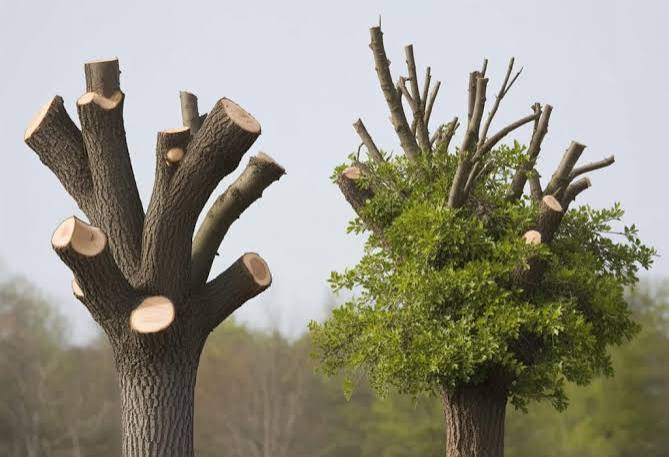
Crown reduction is a precise pruning method that reduces tree height and spread safely. Tree topping is a destructive practice that severely damages tree health. From the street, the two can look similar at first, but their long-term effects are completely different.
Crown reduction involves making a clean cut just outside the branch collar. The cut goes back to a living lateral branch that is at least one-third the diameter of the limb being removed. The tree retains its natural shape, maintains live tissue around the wound, and can close the cut over time. For a southern red oak in Rome GA, a proper crown reduction removes 20% of canopy volume through targeted cuts. The tree then recovers in one to two growing seasons.
By contrast, topping cuts the main leader or major scaffold branches to arbitrary stubs. This leaves large wounds with no lateral branch to redirect energy. There is no living tissue to seal those wounds. Decay sets in from the exposed wood, and the tree responds by throwing out masses of epicormic shoots. These fast-growing, weakly attached water sprouts are structurally inferior to normal branch growth. Topping the same southern red oak often initiates a slow structural collapse over five to fifteen years. This sometimes ends in removal that costs far more than the original work.
Is tree topping bad for my trees in Georgia?

Yes—tree topping is extremely harmful to trees everywhere, and Georgia’s climate makes it worse. Rome GA’s warm, humid summers accelerate the fungal decay that enters through stub wounds. The large exposed wood surface becomes a direct pathway for wood-rotting fungi. Decay can move into the main trunk before the tree has a chance to compartmentalize the damage.
Georgia’s fast growing season is a double-edged factor. Trees do push regrowth quickly after topping, which can look like recovery. It isn’t. Those epicormic shoots grow from surface tissue with weak attachment points. As they thicken over the years, they become heavy limbs with poor structural connections. This creates a hazard scenario, not a healthy tree.
The International Society of Arboriculture (ISA) states that topping is considered an unacceptable pruning practice. It removes the majority of the crown, removes the majority of the leaf surface, exposes large wounds, and stimulates growth of weakly attached shoots. Source: ISA — Why Topping Hurts Trees.
The cost argument for topping collapses under scrutiny. Topping is faster for the crew, which is why some lower-cost operators default to it. But when you factor in the follow-up work—repeated removal of hazardous regrowth every few years, eventual structural decline, and often full tree removal—the total spend over a decade routinely exceeds what a proper crown reduction would have cost upfront.
Crown reduction: when it’s the right call and when it isn’t
Once you understand why topping fails, the next question is when crown reduction actually makes sense. It is the right call when a tree has genuinely outgrown its space and removal is not desired. It reduces overall height and spread through precise cuts to lateral branches, preserving the tree’s architecture. An ISA certified arborist can assess whether a tree is a candidate for this service.
Situations where crown reduction makes sense
- A large hardwood with branches overhanging the roof, where 6–10 feet of clearance is needed.
- A tree growing toward power lines where the utility company will otherwise top it.
- Storm-damaged trees where major limbs have partially failed.
- Trees with a pronounced lean where reducing the canopy lowers the center of gravity.
When crown reduction is not the answer
Crown reduction done too aggressively crosses into territory with similar consequences to topping. Removing more than 25–30% of the live canopy is not acceptable. A crew that “reduces the crown” by 50% is not performing proper crown reduction. The 25–30% limit reflects the tree’s capacity to maintain adequate leaf surface while healing wounds.
Crown reduction is also not appropriate for trees with advanced internal decay, root damage, or severe structural defects. In those cases, the cost is better applied toward full removal and replacement with a well-sited species.
What’s the right way to prune a large tree in Rome, GA?

The right way to prune a large tree starts with a clear objective: clearance, structure, deadwood, or size reduction. Pruning without an objective is how homeowners end up with a tree that is structurally worse than before.
The four-step pruning sequence professionals follow
- Deadwood first. Remove all dead, dying, or diseased branches before making any live cuts. This clarifies the true structure.
- Crossing and rubbing branches. Eliminate branches that cross the crown interior and create wound points.
- Structural corrections. On young trees, remove competing leaders and narrow crotch angles. This phase is minimal on mature trees.
- Crown reduction or clearance cuts, if needed. Only after steps 1–3, and only back to viable lateral branches. Never to stubs.
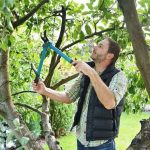
Proper pruning cuts matter as much as what gets removed. The cut should be just outside the branch collar. Cutting into the collar removes the tissue the tree uses to seal the wound. Leaving a stub means it dies back and opens a wound anyway. Neither flush cuts nor stubs are acceptable in 2026.
Timing in Georgia is a real consideration because trees recover best when pruning works with seasonal growth. For most species, late dormancy—January through early March—is ideal. Wounds close faster as the tree breaks dormancy, and many pests are inactive. You can check the best time to trim trees Georgia for a breakdown by species.
The ANSI A300 Pruning Standards specify that pruning cuts should be made to lateral branches with a diameter of at least one-third the diameter of the limb being removed. They also state that no more than 25% of the live crown should be removed in a single growing season. Source: ANSI A300 (Part 1) — Tree Care Operations: Pruning.
Deadwood removal: the pruning job Rome GA homeowners keep skipping
Deadwood removal is the highest-value, lowest-risk pruning service available, and it is consistently underutilized. Rome GA’s summer humidity and rapid fungal colonization mean dead wood deteriorates faster here than in drier climates. A limb that looks solid in April can be brittle by September.
The practical rule is straightforward. Any dead branch over 1 inch in diameter should be removed. Any dead branch over 2 inches in diameter over a structure or gathering space is an active liability. This is baseline maintenance, and it is also the easiest way to reduce avoidable failure risk before more involved pruning decisions are made.
Deadwood removal also reveals a tree’s overall health. A canopy where 15–20% of branches are dead suggests something systemic like soil compaction or disease. Crown reduction will not fix this, and a property owner should understand it before investing in other work.
The honest side-by-side: crown reduction vs topping vs deadwood removal
These three services get conflated constantly by homeowners and phone quotes, so a direct comparison helps clarify the decision. The table below shows how crown reduction, topping, and deadwood removal differ in both short-term results and long-term impact.
| Criteria | Crown reduction | Tree topping | Deadwood removal | Best choice if… |
|---|---|---|---|---|
| Tree health impact | Minimal if done correctly (<25–30% removal) | Severe—initiates structural decline | Positive—removes disease vectors | Deadwood removal for health; crown reduction for size |
| Wound closure | Yes—lateral branches allow callus formation | No—stubs cannot close; decay enters | Yes—collar cuts seal efficiently | Any method that isn’t topping |
| Regrowth quality | Normal, structurally sound lateral growth | Epicormic shoots—weak, hazard-prone | No artificial regrowth stimulated | Crown reduction or deadwood removal |
| Long-term cost | Moderate upfront; low follow-up cost | Low upfront; high total cost over 10 years | Low—often the least expensive service | Deadwood removal for budget; crown reduction for access |
| Recommended frequency | Every 5–10 years as needed | Never | Every 3–5 years; annually near structures | Regular deadwood removal; crown reduction as needed |
Our verdict: what to ask for and what to refuse
Choose crown reduction if your tree has genuinely outgrown its space and you want to keep it. Specify to the crew: “Crown reduction to lateral branches, maximum 25% of live canopy removed, no stubs.” Get this in writing.
Choose deadwood removal if the tree’s size is not the issue but you see dead branches or recent storm damage. This is also the right starting point before any other work.
Refuse topping outright. No price makes it acceptable. If a crew quotes topping as the solution, they are not the crew for this job. The short-term savings will cost significantly more in regrowth management and eventual removal. For pricing context in Floyd County, the tree trimming cost Rome GA page breaks down costs by service type.
Neither pruning approach is appropriate if the tree has significant structural failure or advanced decay. In those cases, the conversation should shift to removal. A qualified ISA certified arborist can make that call with a ground assessment and, where warranted, a resistograph test.
If you’re comparing services across the region, reviewing tree care cost statistics Georgia gives useful context for professional pruning costs. The full scope of ongoing tree maintenance in Rome GA is covered under tree trimming Rome GA.
- Never remove more than 25% of a tree’s live crown in a single year.
- Tree topping in Rome GA is especially damaging because humidity accelerates fungal decay through unsealed stub wounds.
- Deadwood removal is the highest-value, lowest-risk pruning service and should always happen first.
- One question—”What size lateral branch will you cut back to?”—separates qualified crews from unqualified ones.
Common questions about tree pruning Rome GA
What is proper tree pruning in Rome, GA and how is it different from basic tree trimming?
Proper tree pruning in Rome GA follows ANSI A300 standards—removing branches just outside the branch collar, limiting live crown removal to 25% per year, and always cutting back to a living lateral branch. Basic trimming often means aesthetic shaping without those constraints. Proper pruning preserves tree structure and accelerates wound closure.
How do I prune a large tree correctly without damaging it?
For a large tree, always start with deadwood removal. Make each cut just outside the branch collar. Remove no more than 25% of live crown in a single year. For limbs over 4 inches in diameter, use a three-cut technique to prevent bark tearing.
Crown reduction vs topping—which is actually safe for my tree?
Crown reduction is safe when done correctly—cuts to lateral branches at least one-third the diameter of the removed limb, with no more than 25–30% of live canopy removed. Topping is not safe under any circumstances. The ISA explicitly lists topping as an unacceptable pruning practice.
Why is tree topping so common in Rome GA if it’s that harmful?
Topping is faster and requires less skill, so it costs less for a crew to perform. Homeowners often cannot distinguish it from proper crown reduction until years later. Some operators misuse the term “crown reduction” because there is no on-site enforcement. Asking for ISA certification and specific cut specifications before hiring filters out most of these crews.
How much does professional tree pruning cost in Rome, GA in 2026?
Professional tree pruning in Rome GA typically ranges from $250–$750 for a single mid-size tree in 2026, depending on height, species, and access. Crown reduction on a large mature hardwood can run $800–$1,500 or more. Quotes significantly below these figures typically reflect topping, not proper pruning.
How often should I have my trees professionally pruned?
Most established shade trees in Rome GA benefit from professional pruning every 3–5 years. Young trees require pruning every 2–3 years to build proper structure. Trees near structures or power lines may need annual deadwood checks. An ISA certified arborist can recommend a schedule for your specific trees.
The bottom line: For tree pruning in Rome GA, you have two safe options: deadwood removal for health and crown reduction for size reduction. Topping is never safe. The quality of the pruning depends entirely on the cuts made to lateral branches and the percentage of live crown removed. Always hire an ISA certified arborist and ask specific technical questions before any work begins.
See also: tree trimming rome ga
See also: tree trimming cost rome ga
See also: tree care cost statistics georgia
See also: tree trimming rome ga
See also: tree removal rome ga
See also: crepe myrtle trimming rome ga